Monday, July 8, 2019

Take a left where the map says right

Where are we even headed to?
Moving at the speed of light
So numbed down, 
we hardly feel the flight.

Driving around in a maze
Pretending we could trust the map
Handed to us, so we're stuck in this loop, 
wearied out, lobotomized.

Tinted windows never rolled down
Too afraid to let the wind ramble
For it might tell you truths that hurt
Truths you block out, for comfort. 

Never letting the naked eye see
Zombies behind a camera lens
Painting dull frames with pretty hues
Thank God for filters that mask the blues. 

Building walls around you thick and high
Of caste, of colour and injected hate. 
Pointing a gun at the figure ahead
Not knowing it's you on a shadow screen. 

Never the sail fully opened out
Too scared the wind might slow you down
Or take you to waters not marked out
To islands that don't house your tepid towns.

Scared to stop for even just a while
Lest you fall behind on track
What a shame it would be to slack
To not be part of the winning pack. 

But it is a race you can never win
You're always short by a foot, by an inch. 
And if you reach the mountain top
There are higher ones to climb, to scour.

This is a game you can never win
Designed to make you think you can. 
So sit back, relax, 
Roll down that glass
Feel the wind as it knots your hair
Listen to it sing, open your ears. 
Take a left where the map says right
Learn to let go of things you were told to hold tight. 
One day may be you'll reach somewhere
From where you needn't run in despair.

- Ardhra Prakash
 (July, 2019)

Tuesday, February 19, 2019

Belonging

I don't really understand it when people talk of wanting to belong. 
I like being a tourist
Fleeting past people and places
Backpack on, water bottle on the side, a sling bag with the essentials
All that I need for a few days to come.

I like being a tourist
I like meeting the strangest of people and 
pretending not to understand a word they say to avoid a conversation
I smile and nod and look away
I couldn't do that to my own
I wouldn't have homes to come back to then. 

I like being a tourist
To not be part of anybody's world
But be a visitor
To see you put on your best behavior for me 
Or sometimes even be ignored
With no burden of a meeting ever again
No burden of the need to collect favors for a rainy day.

I like being a tourist
Thinking passively about a home I collect souvenirs for
A home I can't wait to get away from
And a home I can't wait to get back to
Only to want out again.

Am I even a tourist, but? 
What is my destination? 
Does it matter where I am heading?
As long as I have the open road ahead of me 
And quick change to get me by
And a home to head back to
Do I even need to introspect?

It doesn't matter where I go, what I do, 
It's this few hours of detachment that counts.
This freedom and the high it brings. 
The freedom of not having to belong
The freedom of not having to perform
The freedom of not being a guest at your own home
The freedom of being just someone you meet in a bus
Only to forget.


- Ardhra Prakash
  (February, 2019)

Tuesday, August 21, 2018

God's Own Country to Country Of Gods: Kerala's Survival Story


Read about how Malayalis and the world came together to pick Kerala up from one of the worst disasters of the century below. Report for The Incisive Journal, from Kerala.


 “It is a terrible time to be alive in a terrible world. I have decided not to procreate. My progenies deserve better than what the world now could offer them.” I declared to my mother the other day. She nodded routinely as she continued the postprandial drill in the kitchen. I reiterated that I was serious as I scrubbed away grease from a pan aggressively. She reminded me that she was listening. This pattern of dialogue happened regularly. I had given up hope in the world. But the past week makes me rethink.

Kerala and its rains are inseparable. Monsoons are welcomed with great familiarity. The amount of rain it receives annually is thrice as much as the national average. Apart from the fact that it feeds most of our 44 rivers enough to keep us green throughout the year, only marring the map with isolated water logging, it has also been a part of cult literature. What better example than P. Padmarajan’s Thoovanathumbikal and its “rain swept love”. Rain is as much a meaty character in the saga as it has been in our lives. This was my first monsoon back home in years. I have to be honest. Mumbai monsoons are not as enticing as movies make it sound, to someone from Kerala. Naturally, I was as happy as I could be to relive it. This monsoon too was pretty uneventful excepting a few incidents of water logging and flooding in Kuttanad, an area that is always hit. That was until the 8th of August, 2017.

Incessant rains lashed the state, now estimated at a 164% excess in just the last one month. Rains flashed a face of it to us that we were hardly familiar with. The excitement of watching the sluice gates of Idukki Dam open after 26 years soon turned to anxiety and anguish. Landslides and mountain erosion in various parts of Kerala added to the severity. 35 out of the 42 dams  in the state were now open simultaneously. The rains showed no signs of subsiding. Rivers swelled with flood waters taking down 12 of the 14 districts. Even after continuous warnings, cautions and alerts, most of Kerala was caught unprepared – the rich and poor alike.


Disasters have always been something I have watched on the news and sympathized with. Nothing too real. Just enough to may be make me contribute to a relief fund set up. On the morning after the 71st Independence Day of India, Malayalis all over were busy connecting to friends and family spread across the state. Some were trapped in their buildings, others trying to move out of it. Regional news channels were abuzz with horrifying telecasts of the flood and the allied rescue operations. The state forces already in alert were up and active and were soon joined by the central defence in how much ever numbers they were deployed in, but compared to the sheer magnitude of impact, it felt like a needle in a hay stack. Government machinery functioned meticulously, spreading helpline numbers, delivering accurate hourly updates via social media handles. Meanwhile, water kept devouring entire houses and soon we realized that this was a disaster like never before. By the end of the day desperate calls for rescue began appearing on social media either posted by victims themselves as the last of their phone battery drained away or by relatives or friends panicking as they lost contact with trapped kin. Hours of uncertainty followed.

Let me pause and circle back to where we started. To the fundamental question of whether I would procreate? May be, yes, I now would. What changed my mind? People around me did.

As soon as calamity struck, I watched in awe as local people stepped into ground zero without second thoughts, putting together make shift rescue boats and floats. Using storage barrels to inflated tires, to making human barricades held together by trust and sweat, they helped thousands to safety, either assisting the existing rescue forces or by themselves. No one waited for orders or promises of rewards and accolades. They just took charge.

Social media was instantly put to good use. There was an explosion of, mind you, all valuable information, from a constant supply of helpline numbers to sharing google map locations or coordinates of victims. When non-resident Malayalis posted panic stricken messages about how they lost contact to their families, they were immediately pacified by hundreds who helped share information until they reached the right hands. I remember making around four calls that day to rescue teams to report stranded families of people I have never seen before and bursting into bouts of happiness when someone retracted a post announcing the families had been rescued. Meme pages that are constantly accused by the older generation as nothing but mere distractions, turned into control rooms orchestrating rescue operations. Actors, comedians, comic creators or simply put, anyone with a sizable social media following became a source of information. Brilliantly, IT department of the government launched keralarescue.in to integrate the activities of government officials and volunteers. Anbodu Kochi, an initiative that started in 2015 to extend support to Chennai during floods, had already started the groundwork for the next important phase after Rescue – Relief. And while the national media seemed to want to disregard the catastrophe, individuals circulated the news via social media to gain national and international attention and assistance. Local news channels refrained from third rate ‘discussions and debates’ and stuck to reporting the situation at ground zero with the help of their many brave and driven journalists. Take notes, national media!

From flood affected areas came out stories of trapped families redirecting rescue workers to more vulnerable areas especially single storied houses where the inhabitants now had nowhere to go as water gushed above the ground floor into the terraces, thereby prioritizing and ensuring that relief was received where most needed. I heard of people determined to survive, rationing supplies among the many present, collecting rainwater to drink and pacifying each other. I am sure all of us were jittery as we saw a woman in labour being lifted into the helicopter, who was dropped at a hospital just in time to deliver a hale and hearty baby. Many such stories, some heart wrenching, some heart-warming, filled the news.

Soon enough, came the most important of all the heroes Kerala witnessed in the last few days. The Fishermen. The ones who really picked us all back up from despair.  As soon as the news of the gravity of the situation spread, 2884 men picked up 642 boats and traversed long distances from as far as Thiruvananthapuram over trucks to reach affected areas of Thrissur, Pathanamthitta and Ernakulam districts. They cruised through unknown lands of varying water levels, all in the hope that their valuable skills of handling rough waters, would help them through the harsh currents to save lives. And they did so splendidly. Of the two lakh rescued from severely flooded areas, it is estimated that more than a lakh have been by these heroes, without capes, but with paddles and propellers. Many were injured in the process and their boats were severely damaged. But they smile heartily sharing that they were even prepared to sacrifice their own lives if they had to, to save another. Kerala just can’t seem to find enough words to thank their own “army” as they have been rightly described by the chief minister, Shri. Pinarayi Vijayan.
                                            

Pinarayi Vijayan. He will always be remembered as the man who kept Kerala away from scattering into a million panic-stricken pieces at the time of a calamity of this magnitude. I often joke that this man has been suffering since he pledged to be our chief minister. Ockhi cyclone in 2017, Nippah outbreak earlier this year and now the worst flood Kerala saw in a century. Had he panicked or not had his well-oiled machinery prepared to carry out every bit of his action plan to the best of human ability, the extend of death and destruction would have been much higher. He remembered to be self-assured in the face of uncertainty and lead us into believing that we, as a team, were enough. That is a lesson I shall take with me to my grave.
                                                         
Officials worked round the clock. Rescue operations went late into the night only pausing briefly until day break due to visibility issues. The teams flung into action again at the break of dawn since a single second wasted could mean another life lost. Army and Navy helicopters had the difficult task of rescuing people from the rooftops of houses inaccessible by boats due to extremely harsh water currents, while ensuring that the wind did not cause further damage to rooftops and roofing sheets and thereby to humans near it. From cabinet ministers to opposition leaders and party members, everyone were directly involved in coordinating the rescue and relief efforts. MPs, MLAs and members of local bodies ensured their constant presence and extended cooperation by uniting beyond petty politics. The health department under the very efficient Shailaja Teacher focused on ensuring medical assistance in camps and containing the spread of water borne diseases that usually follow catastrophes such as these. Revenue department employees worked through the night scanning through piles of information and let me not forget to mention the Kerala State Electricity Board employees who worked through pouring rains to re-establish electricity at times of power failure to assist rescue and avoid casualties via electrocution from damaged wires. A big salute to all of the Kerala Police Force who have been working tirelessly for days now. Though underappreciated, they are still very much involved with rescue and maintaining law and order through these tough times.

The young and feisty District Collectors were at the forefront inspiring, invigorating and integrating volunteers and relief activities. Most importantly they made sure that no one took undue advantage of the calamity. Shopkeepers marking up prices excessively at the time of shortage were caught red handed. In case individuals were reluctant to hand over resources vital to rescue, it was ordered to be handed over to the police.

But the most inspiring thing about the past one week has been that we managed to find the true meaning of the word “heroism” and we managed to find it inside each one of us. When I started making calls to random numbers I was passed on by another set of strangers, most of who were not even physically present in the state, to see if I would be able to manage any resources at all for my town which was cut off from the rest of the world, I was instantly linked to a group of similar individuals and groups trying to do their bit just like me. And together I felt we could move mountains if we wanted. I came across individuals who transferred materials and money to each other without having spoken previously at all, united by a need to overcome. I spoke to people who were constantly travelling from camp to camp, chipping in whatever meagre amount they could, losing out on valuable days of work. None of us asked each other of our political preferences, skin colour, affluence, caste or religion and any similar attributes attached to us by mere accident of birth.


And when there were, as my friend rightly and profoundly said, “thoughtless morons who could be considered outliers compared to the sizable number at the centre,” who were spreading gross and selfish 
lies disregarding the damage and impact, we pacified each other reminding this was not the time to be distracted. This was the time to move ahead of what happened, to move forward, to “make history.”


You can help us rebuild and rehabilitate the lives of  hundreds among us by making donations at  https://donation.cmdrf.kerala.gov.in/ . Every rupee counts. Remember, together we can move mountains!


(Please note that I do not own the rights to any photographs above. Please let me know if you have an objection with me using your creatives and we shall get it removed as soon as possible.)
#disaster #disasterrelief #kerala

Ardhra Prakash
(21st August, 2018)

Why Chief Minister's Distress Relief Fund?


Kerala has been reeling under monsoon fury. According to official reports, the infrastructure loss has been estimated at close to Rs. 20,000 crores. Please donate to the best of your ability to the chief minister's relief fund, however small it might be.
Prayers and gratitude to the volunteers, forces and officers who have been doing a meticulous job saving others while risking their lives and even the back end team for providing timely information and instructions regarding rescue and relief every hour of the day.
                              

To pinpoint, you could say Kerala floods started on the 8th of August. Soon enough the Chief Minister's Disaster Relief Fund was announced and contributions were encouraged. Be it people within the state or all the kind hearted friends from other parts of India flooding me with calls of anxiety about our safety and a will to extend help, a common response I receive to suggestions to donate to the CMDRF is whether it is trustworthy. Let me explain why it is
1. Accurate accounts of funds received and utilized need to be furnished in the legislative assembly.
2. Anyone can access full information on the transactions on the find via RTI and thus is transparent.
3. Directly controlled by the state government who are in touch with the requirements of the citizens. Over the last 2 years, 435 crores have been distributed among 2.35 lakh people as disaster relief.
4. Wellswishers get 100% tax exemption on the amount donated.
Personally I feel that rather than donations dissipating to a million smaller funds, seems like it is easier to keep track of one fund. Any fund we donate to could be misused. But this one seems more accountable and is required for infrastructural development.
The magnitude of damage inflicted by the flood is unprecedented. Leaving apart rescue and relief work which in itself is costly, the state is now faced with the Herculean task of rebuilding infrastructure and rehabilitating the displaced, through out the state. The damage has been estimated at about 20000 crores as of yesterday. Even if we are to undertake the redevelopment on a war time basis, it is going to take this small state years to get life back to normalcy and back into the path of development.
Hope this helps put out doubts from your mind with regards to the dependability of Chief Minister's relief fund and contribute as much as you can.

To donate


: https://donation.cmdrf.kerala.gov.in/

or NEFT/IMPS/RTGS
Bank : State Bank Of India
Account Number : 67319948232
IFSC Code : SBIN0070028

#WeShallOvercome

Thursday, November 30, 2017

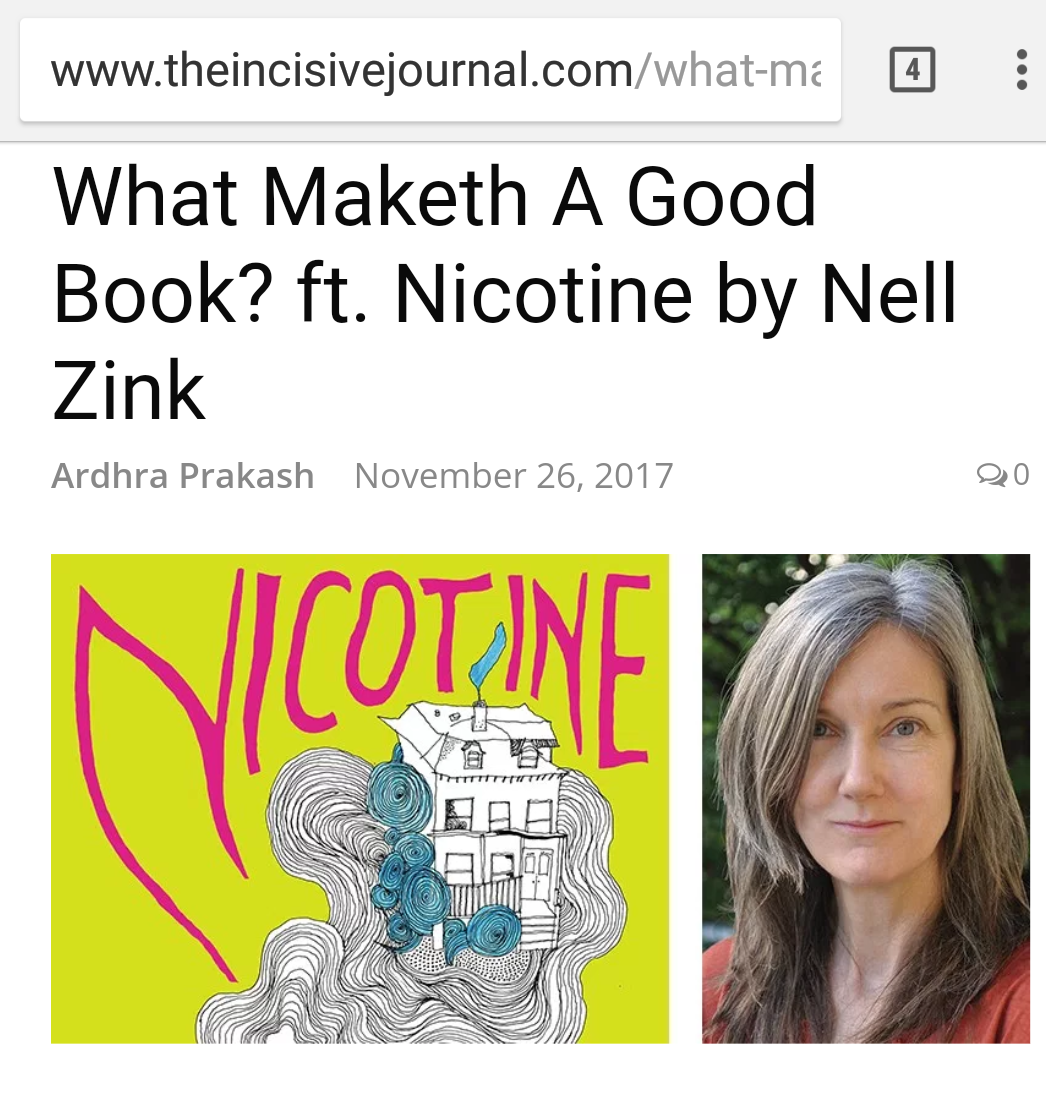
What Maketh A Good Book? ft. Nicotine By Nell Zink With The Incisive Journal


What makes a book, a good book for you? Find more about about how Nell Zink's Nicotine proved to be a reading milestone for me here.


What makes a book, a good book?

This question floated into my brain an early November morning and left me perplexed. I had just put down Nell Zink’s much acclaimed fourth novel Nicotine a few days prior and wanted to review it. But I was just as confused about the book after I was done with it, as I was while reading it. Is this a good book? I was clueless. So, I looked up the definition of a good book and even randomly put this question to some people I know who read.

Google showed me some articles that provided tips to guarantee the flawless book – catchy opening, solid storyline, good characterisation and it went on and on. As to the real people I had approached, the initial replies were mainly suggestions and their type of preferred genre. I made myself clearer. I wanted to know what made a book of any genre appealing to them. What makes them smile after they are done with a book and lock them up in their heads not to be forgotten soon but to be shared among others as intimate suggestions? Though it took some time for everyone to get over the randomness of that question and tell me crudely what made them love a book, they all made sense.

Before Nicotine

I used to prefer, note the past tense, beautiful writing, not too complex that like Jane Austen’s Pride and Prejudice described by fellow social cataloguer as “language that could be beautiful, ends up difficult to decipher and you find yourself going back to those paragraphs again and again only to be left unsatisfied” or not too simple like say Chetan Bhagat who chews your steak for you. Books with a definite story line – an introduction, the build-up, the climax, not necessarily in the same order. Yes, multilinear and multiple narratives.  Naïve me thought I was an adventurous reader because I was happy with these multi-s in my read. I required humour, philosophy, drama, realism and all in the right proportions for me to like a book.

Age of Nicotine – my forbidden fruit.

But just like how the forbidden fruit changed the course of humanity post the original sin,  Nell Zink’s Nicotine changed it all. It showed me that a writer is not supposed to give a rat’s arse about what the reader wants and the reader is not supposed to tell a writer how to do their job. My reading graph after Nicotine hereby shall be divided into 3 eras – Before Nicotine, Age of Nicotine and After Nicotine and I had not one clue when I purchased it. Nicotine was supposed to be a funny, easy read.

Briefly, Nicotine is about a very young business graduate Penny who loses her very old and rich Dad and is suddenly out in the world without a purpose. Jobless, homeless and suffering from PTSD, Penny is manipulated by her family consisting of her young mother and two half brothers to reclaim their ruined ancestral property now occupied with squatters who have come together by a common love for tobacco, so strong, they name their home Nicotine. The very squatters become her new family and welcomes her to their anarchic, confusing but supposedly driven by a cause life.  It is not the perfect book. It is named after Nicotine but rarely gave much importance to it other than a lot of mentions. It is hard to relate to at times. It becomes the anarchy it tries to portray, may be intentionally. It strays from the path off and on, making the pseudo progressive in me uncomfortable.

Nicoine cover image

The story starts off promising a typical American coming off age movie. As Penny introduces herself as a fellow homeless anarchist to the squatters at Nicotine, you expect the tried and tested trivia of pretences and the attached drama once the truth is unmasked generally towards the end of the story but you are not served what you expect. The truth is revealed to the inhabitants of Nicotine by a third person pretty soon into the book and there are no tears, yelling or talks of betrayal. They all shrug their shoulders and get busy.

Another interesting part is when Amalia, the young mother tries to describe her take on the cosmic snake. Penny is trying hard to make a moment out of it. She wants her mother to make sense. Just like she had just corrected Penny’s assumption that in a sexual relationship between a 16 year old boy and a 12 year old girl, the older male doesn’t necessarily have to be the abuser and it could be the other way just as much. Penny is pretty flawed, confused and lost throughout the story just like the reader I was throughout the book and the ending really doesn’t change that. You could even say that is exactly the type of reader I was with this book.

If you look at other reviews of Nicotine by professionals, like the New York Times or the Guardian, they all seem to say the same thing. The book is a mess. There is no binding story line, the plotline is actually rather bizarre and not very satisfactory owing to the fact that it never really gets anywhere. The characters are fresh but they don’t change dramatically for the good or bad over the time period of the story but rather merely gets by every day. What else could I say about a novel where the protagonist takes up a bank job while conveniently living as a squatter to save upon rent? Where’s the betterment and where’s the redemption? May be this complete lack of reverence to any binding norms is what makes this book so special. It is fresh and it is funny.

After Nicotine

But as a writer Nell Zink is the right dose of funny, serious, sarcastic, silly and refreshing. The book is not a treat to my brain who demands a story. But it is unputdownable (add to dictionary) and hilarious, at the same time thought provoking but not preachy. Hell yes, I am suddenly more open to books not conforming to my idea of writing and that I think is our most remarkable achievement as the reader- writer duo and now I am a proud peruser ready to take up more unconventional reads. 

Nell Zink - the author


May be this is what books are supposed to do – give the comfortable reader a slap across the face and ask them to stop being so boring, help you evolve as a reader.  Many thanks, Nell Zink, I may not love your book and might not rate it a 5 star if I had to, but I would always be thankful for it.

Ardhra Prakash
26th November 2017

Tuesday, November 14, 2017

"Exit West By Mohsin Hamid: Refugee Crisis Through Magical Realism"


Find my extended review of Mohsin Hamid's Exit West for The Incisive Journal here. Disclaimer:  This article contains spoilers.  Skip paragraphs 6 and 7 to avoid them.

I am a bibliophile. But what I also am is broke through most of the month. A very normal condition for someone who recently changed jobs, have to pay rent and put food in their tummy while  living a couple of states away from the parents who once did all this for me only to be taken for granted until a brief time away. So, when I came across Mohsin Hamid’s Exit West impacting readers across the world in my Social Cataloging Site and driving Bookstagrammers crazy in my Instagram, I am not proud of it but I sent puppy eyed messages to my loving father asking him to order it for me. And he did. I got back home after a few long months and my father presented me with this perfect welcome back “gift.” Exit West is my first Mohsin Hamid book but certainly not the last.

Let’s forget for a minute, the beauty of the writing, the literary treat the book offers. Relevance is one of the biggest achievements of this book.

According to the UN High Commissioner for refugees, more than 65 million people have been displaced from their country of residence and/or origin, due to social and political conflicts, violence or human rights violations. This is the highest ever since World War II, constituted mainly by 5 nations – Syria, Afghanistan, The Lake Chad Basin, South Sudan and Somalia. The book stands wildly significant for me being from a country where the idea of burning Rohingya Muslims alive is applauded by privileged apathetic trolls bend over their computers and iPhones hurling abuses and threats, wherein we could’ve ended up on the wrong side of the border just as easily, by mere accident of birth. The same accident that lets me complain about being broke while I can very well feed, shelter, clothe myself well in a world where that remains a luxury to many.

In this beautiful book, Mohsin Hamid talks about the fate of millions of Nadia’s and Saeed’s, our protagonists, pot smoking youngsters from “a city swollen by refugees, but still mostly at peace, or at least not yet openly at war” in an unspecified country. Nadia is the independent working woman who chose being abandoned by her family over being a slave to nonsensical societal norms and propriety, daring to earn and live alone while Saeed is homelier and more conservative but when they meet and discover their budding love in a world that was just beginning to fall apart around them, they decided to hold onto each other a little tighter. Their seemingly normal lives are soon shaken by civil war from where magical doors take them to refugee camps across the globe here they need to build their lives from the handful of belongings they could fit into a backpack. These magical doors, guarded by the militants or the military, hard to find and expensive to get through, are a convenient metaphor to un-complicate a complicated, twisted reality, the migratory journey itself.  The story focuses on how the world and the people in it matures around these god forsaken times rather than the journey itself. But beyond the label of refugees, migrants and religion, Saeed and Nadia are human beings, youngsters, just like you and me, excited by that song, a magic mushroom, a tight rolled joint. Like it could’ve been you or me.


And while you relax thanking god for having been spared of these casually yet powerfully conveyed perils of 65 million fellow humans, he tells you, “…. everyone migrates, even if we stay in the same houses our whole lives, because we can’t help it. We are all migrants through time….and when we migrate, we murder from our lives the ones we leave behind.”


It also gets to me how subtly he takes us through the life of the once passionate couple as they grow apart unable to preserve what they had once, to remain unscathed after the tiresome journey that almost consumed them. “In the late afternoon, Saeed went to the top of the hill, and Nadia went to the top of the hill, and there they grazed out over the island, and out to the sea, and he stood beside where she stood and she stood beside where he stood and the wind tugged and pulled at their hair, and they looked around at each other, but they did not see each other, for she went up before him and he went up after her, and they were each at the crest of the hill only briefly, and at different times.”

No, it is not a happy ending for Nadia and Saeed’s romance. But it is a happy ending for the individuality and friendship they share. Of course I did feel uncomfortable reading the ending where the protagonists does not rekindle their relationship and walk holding hands towards the sunset. But that’s just the years of conditioning our movies and literature inflicted on us, reiterating the notion that the boyalways gets the girl. But maybe, it’s not about the boy and the girl and if they end up in each other’s arms at the end of the day. May be it is about how the boy and the girl blossomed into who they are today. Survivors with a journey they could be proud of. Chillingly casual and hauntingly mundane in the midst of the end of worlds, this book is definitely a good read.


Ardhra Prakash(14th Novemeber 2017)

Friday, November 10, 2017

Book Review: Dark Places by Gillian Flynn

Dark PlacesDark Places by Gillian Flynn
My rating: 5 of 5 stars

"I have a meanness inside me, real as an organ. Slit me at my belly and it might slide out, meaty and dark, drop on the floor so you could stomp on it." So begins the third Gillian Flynn thriller I read after Gone girl and Sharp Objects and I am absolutely bowled over.

Narrated from the points of view of the Murdered, the Accused and the Survivor, Dark Places pulls you into that big dark reading chair and even after you realise you're trapped, you don't want to leave before you read the next page and the next and then the next.

7 year old Libby Day is the sole survivor of the Kinnakee Satanic Massacre that left her 35 year old mother and 2 sisters aged 9 and 10 dead, which the world believes was conducted by her 15 year old brother Benjamin Day, also an alleged Satan worshipper and child molester. 25 years later, Libby is approached by Lyle Wirth, a member of the Kill Club, a group that solves murders and mysteries, obsessing over the case and convinced Ben is wrongfully convicted over the testimony from a 7 year old's unreliable memory. Exhausted of the money raised by charity for her support 25 years ago, baited by the lure of money by the members of Kill Club, Libby is compelled to look into the past. And once she embarks on that journey into her "Dark Place", there is no turning back.

Apart from the essential ingredients that make a best selling crime thriller - suspense, grip, sneak peeks of clues scattered through out that your head tries to work up like a puzzle, the book also has a certain poignancy and character attached to it. Like all of the "effortless storyteller's" other characters - Ben, Patty and Libby, The Days, my narrators, leave you hurting for them. All this while always keeping the rein of the story line tight and commanding the parade to a grand finale..
Yes. Yes. Yes. You got the point. Go get the book. 💁


View all my reviews

Thursday, October 26, 2017

"Lolita: Pure Perversion or Sheer Brilliance?" With The Incisive Journal


If you have run through my blog before, you would know that I've already published a book review on Lolita. Well, here is another take on Lolita - an article I re worked for The Incisive Journal. Though the base review remains the same, it is a much deeper dive into the book and the characters. Enjoy it below. 


“Lolita, light of my life, fire of my loins. My sin, my soul. Lo-lee-ta: the tip of the tongue taking a trip of three steps down the palate to tap, at three, on the teeth. Lo. Lee. Ta. She was Lo, plain Lo, in the morning, standing four feet ten in one sock. She was Lola in slacks. She was Dolly at school. She was Dolores on the dotted line. But in my arms, she was always Lolita.” 


Disgustingly brilliant. Pure perversion. One of the best books in modern literature. These are a few among the thousand descriptions you’d find for the book by Russian – American novelist Vladimir Nabokov, among reading circles. As a reader who relies heavily on reviews before picking up a book, the social cataloging website I frequently use for the same, bombarded me with mixed reviews, including one that said, “I never understood when an old friend used to say ‘Ulysses’ was a good book to read but not a good book to “read”. Lolita changed that.” 


And Lolita was all that and much more than it promised to be. It has been one of the most strenuous reads
of my life. A book that never let me lay back in peace, but rather had me cringing at the edge of my seat, worried if I was sinning against the “nymphet” Lolita or Dolores, 12 years, by lending ears to Humbert Humbert, an English professor is driven by desire, wanting his Lolita so badly that it never occurs to him to cum pedophile cum stepfather to the title character. “Humbert is every man who consider her as a human being, or as anything but a dream figment made flesh.” Elizabeth Janeway, The New York Times. 


Yes. Lolita is not human. Lolita is not Dolores. Lolita is Humbert’s desire, his obsession, his vulnerability, his inhumane passion, his excuses. Lolita is an explanation that the protagonist offers not to the reader but himself, desperately trying to a person. Proffered with such passion, it is terrifyingly poignant and untangle himself from the heinous crime of destroying a childhood and thereby, unnerving making you want to constantly remind yourself that it’s all a farce.


Humbert, the unreliable narrator here, overtly uses quite a few tools in the process, including a long dead childhood love he could never possess, intentional misinterpretation of Lolita’s helplessness as participation, his vehement attempts in conveying to the reader his good looks and desirability, the reason he believes Lo fell in in love with him just as he did for her. Yes. Above all, he tries to believe he was in love.


Lo isn’t portrayed as a child, but a rather glossy remnant of the paedophile’s memory. But once in a while, the narrator cannot but help l0ok at Dolores as a child he wronged, looking at her suffer and winch in his arms but he quickly tries to shake it off as her mood swing, a tease, Lolita used, to torture him with. His little monster. This is where Nabokov succeeds in making the smartest choice of employing solipsism or less technically put, simply the irrelevance of anything other than oneself. In the narrative, Dolores the 12 year old child is absent. What is offered is only the Lolita he carved out of her, his seducer.


Initially branded an erotic novel, Nabokov observes himself in his afterword that the few initial pages does mislead some readers (I believe, intentionally) into assuming this was going to be a lewd book expecting the rising succession of erotic moments but they are soon consumed by disappointment as the narrative changes form and starts barely mentioning the sexual encounters while focusing rather on the emotional consequences of his actions on Lolita but mostly on himself.


Published originally in English by a writer for whom the language isn’t even his first language, there is undeniable beauty and a concrete imprint left on the reader. As Humbert walks out bloody after murdering Quilty, Lolita’s wrongdoer and drives into the arms of the police, consumed by the guilt of what he had himself done to the child that she had been, one of the rare moments when Lolita is humanized, Nabokov has already drilled a hole in your heart but the head is exploding with compliments for the roller-coaster ride the writer created for you between the pages of this book.


Falling in the category of cult classics and path changers like Lady Chatterley’s Lover, born much ahead of its time, Lolita is that treasure of a book waiting to be savoured by you, if you can handle strain and are not easily rattled.

Ardhra Prakash
(26th October 2017)